








Now that the fever of the 2026 world cup is coming to an end, it’s clear that the 2026 World Cup has set a new benchmark for Live Sport Production. Covering 104 matches across 16 venues in Canada, Mexico and the United States, Host Broadcast Services (HBS) delivered every game in UHD HDR while generating close to 9,000 hours of content. This level of production required distributed media infrastructure and teams on a scale unseen before.
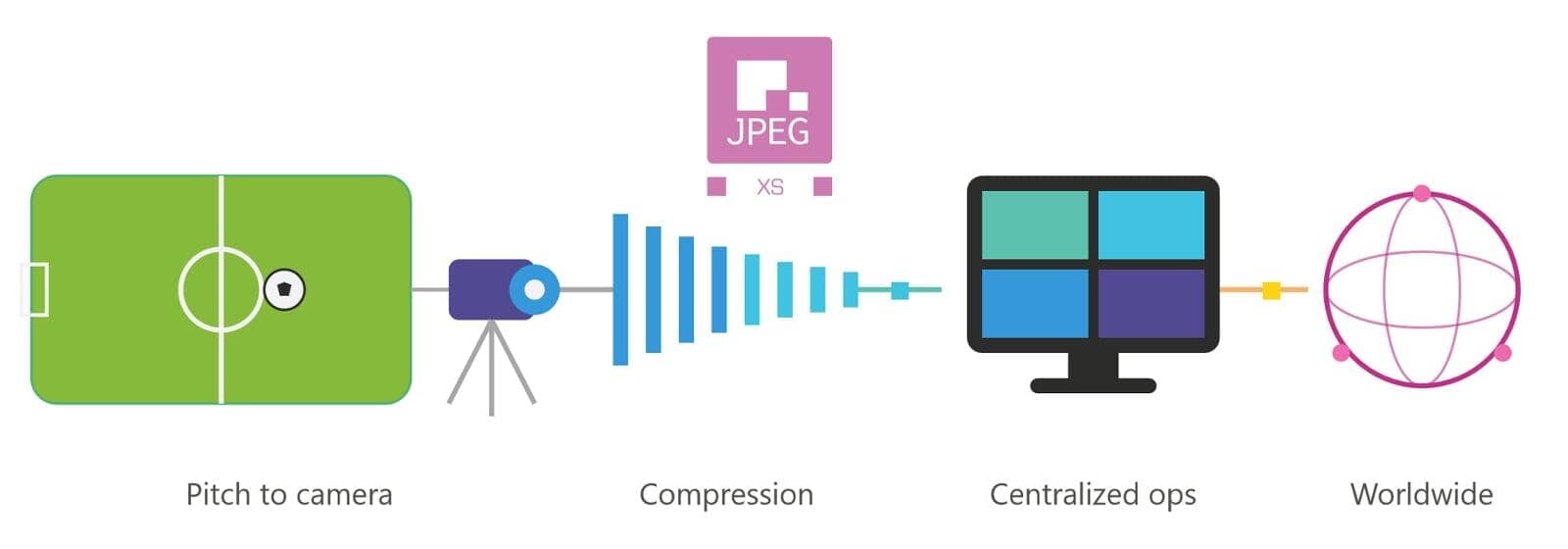
Centralized Operations, Distributed Venues
While local Venue-Based Production was used with 16 local production teams, HBS centralized replay, graphics, camera shading, and audio mixing at the International Broadcast Center (IBC) in Dallas. Moreover, post-production was also centralized in the Non-Live Production Hub in London, where editorial teams produced highlights, features and digital content for worldwide distribution.
The Extended Stadium Feed (ESF), which served as the primary programme feed, was transported uncompressed using ST 2110 in UHD resolution from venues to the IBC. However, with around 45 cameras per stadium and network capacity constrained to 100 Gb per redundant transport path, additional feeds were carried using JPEG XS. Operating at around 10:1 compression, the video technology significantly reduces bandwidth consumption while preserving visual quality and maintaining sub-frame latency. Its native integration within ST 2110 environments also allows compressed and uncompressed streams to coexist seamlessly within the same workflow.
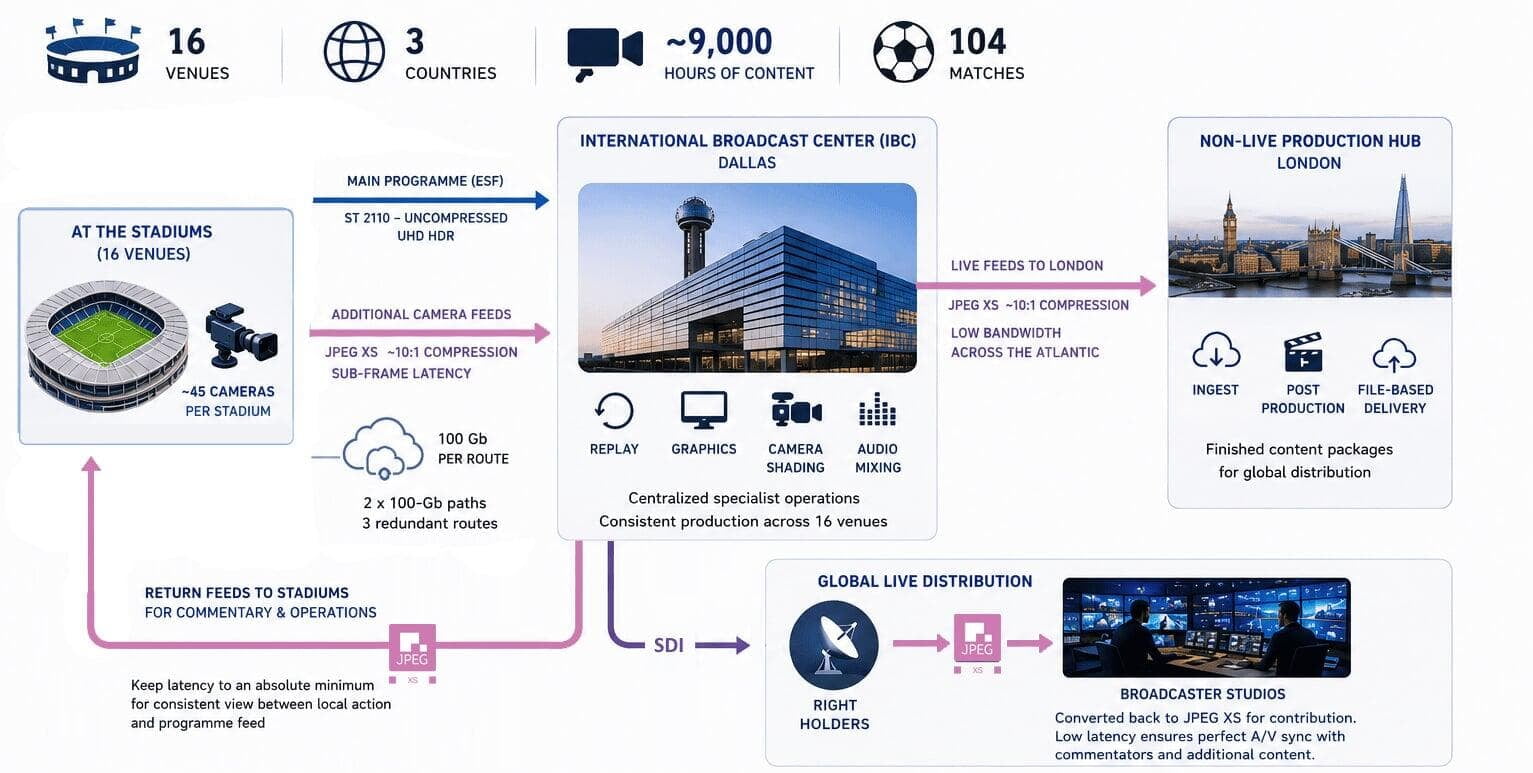
Low-Latency and Sync, Throughout the Entire Delivery Workflow
Remote camera shading was one area where these capabilities proved particularly valuable. Many games were played under changing daylight conditions, requiring continuous image adjustments to maintain a consistent visual appearance. By transporting camera signals with JPEG XS, operators based in Dallas were able to monitor and control cameras located thousands of kilometres away while preserving the responsiveness required for live production.